Recently, the preferential credit package for solar power installation industrial enterprises (SLP) has been deployed by a number of banks. Along with that, the Ministry of Industry and Trade and the Electricity sector also provide guidance on electricity trading. These are considered solutions to solve problems for businesses who want to invest in rooftop solar power projects (RSPPs).
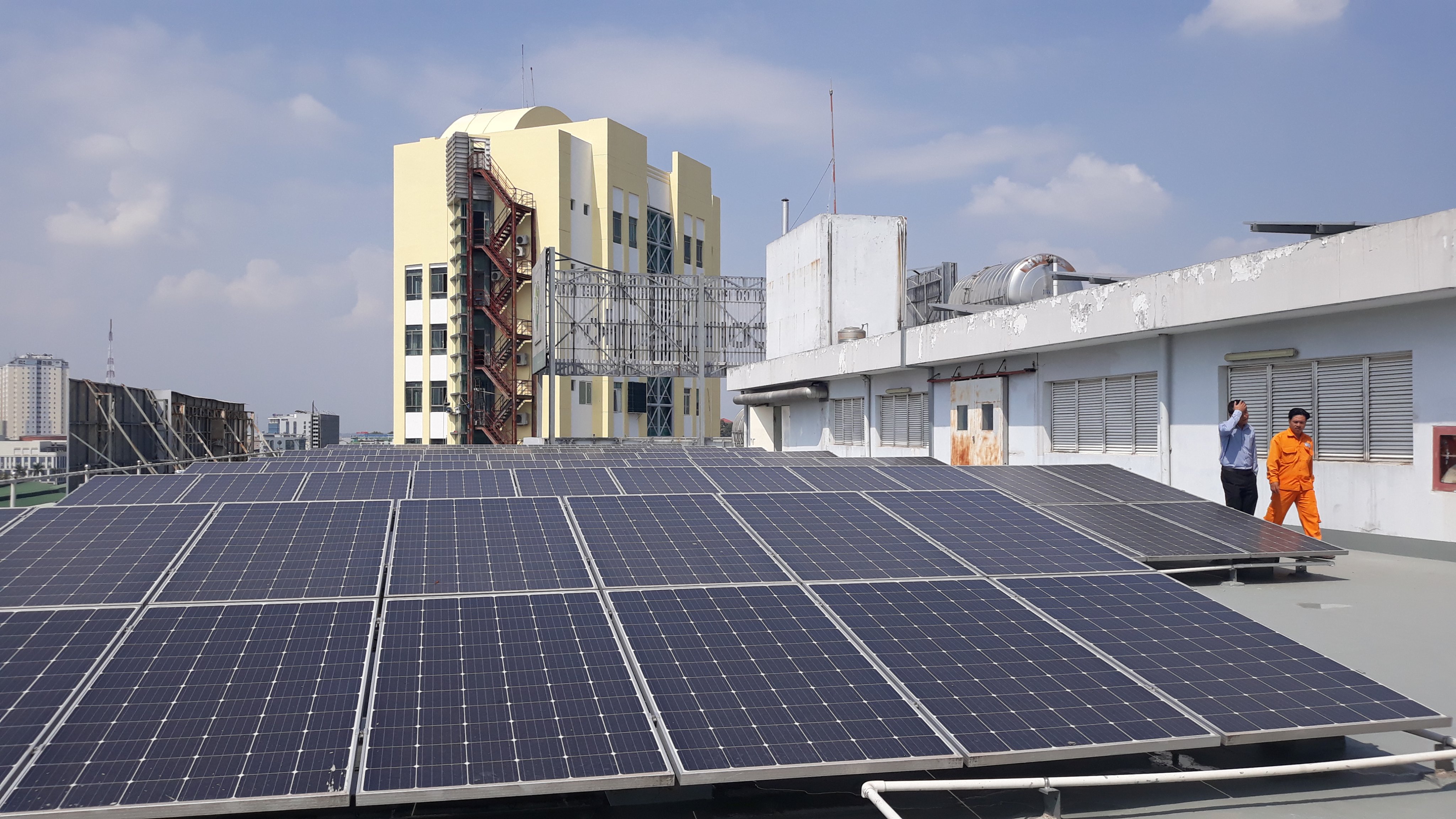
Rooftop
solar power projects (RSPP) in Bien Hoa City.
Outstanding problems
According to Decision No. 13/2020/QD-Ttg of the Prime Minister dated april 6, 2020 on incentives for development of solar energy in Vietnam, Enterprises, households, investors who install PV works with a capacity of not more than 1MW (or not more than 1.2MWp), directly or indirectly connected to the grid with a voltage of 35 kV or less at the end of the day December 31, 2020, will enjoy a fixed price of about VND 1,940 per kWh (equivalent to 8.38 US cents per kWh) for 20 years. This is considered a “push” to create momentum for RSP development.
In fact, after Decision 13 was issued, many solar power projects have been deployed and successfully distributed to the grid across the country. In Dong Nai, as of the end of September 2020, more than 3.2 thousand customers have installed rooftop solar PV with a total installed capacity of more than 80MWp, the total output generated to the grid is 25 million kWh. However, this number is too small compared to the potential and advantages of Dong Nai. The reason is said to be a cumbersome procedure, making the investor unable to access loan capital.
Ms. Tran Thi Thu Hien, Tuong Lai Company Limited (Long Thanh District) said that they’re very conscious of implementing energy saving projects. In early 2020, this Company has signed a contract to install a 2.3M capacity PV project. Its installation partner is responsible for the legal procedures for such project. The said Company has paid 30% of the contract value, now they want to borrow the amount of about VND 2.7 billion to pay the remaining 70%, but it is not approved on the grounds that the bank has not had a loan for rooftop PV projects. If it is not possible to borrow capital for the project, the project will be in danger of being behind schedule and is not entitled to preferential prices of the Government.
A representative of a company with a hi-tech agricultural project in Xuan Loc district said that for solar projects on people’s roofs and factory roofs in industrial zones, it is easy to identify it as the roof of construction works. But with solar power projects on the roof of agricultural farms, there is no clear basis and no specific instructions from the authorities. In addition, most high-tech agricultural projects are far from existing power lines, and there is no specific regulation that the power sector or rooftop PV project owners must bear the cost of grid connection lines.
Capital support for Businesses
To support businesses to install PV power on the grid, Vietnam Electricity has proposed to the Ministry of Industry and Trade to have specific instructions to distinguish between rooftop PV systems and grid-connected PV systems, creating favorable conditions in determining PV trading prices according to Decision 13. Along with that, the Ministry issues technical standards of the project; legal procedures for installation and connection agreement; loan support policy for investors. The Electricity sector also proposed to only connect and sign electricity purchase and sale contracts for rooftop PV systems without overloading the 110 kV substation in the area.
On October 13 in Ho Chi Minh City, the Ministry of Industry and Trade cooperated with the World Bank Vietnam to implement a credit program for industrial enterprises to re-lend to implement energy saving projects, with the focus on installing PV roof. Accordingly, the World Bank provides a USD 100 million loan to industrial enterprises and energy service providers in implementing investment projects to save energy. In addition, the Green Climate Fund also provides a non-refundable aid of USD 75 million to guarantee commercial loans of participating banks to industrial production enterprises to invest in energy saving. These capital sources will remove a part of the difficulties for industrial enterprises to implement RSPPs.
Senior Energy Expert Chu Ba Thi of World Bank Vietnam said that the World Bank always accompanies Vietnam in the sustainable development of the energy sector, and the implementation of credit program for industrial enterprises implementing the energy saving project is an example. The World Bank will continue to support Vietnam to improve the quality of energy use through a series of programs and projects using energy economically and efficiently in the period 2019-2030.
Mr. Phuong Hoang Kim, Director of the Department of Energy Conservation and Sustainable Development, Ministry of Industry and Trade, said that over the past time, the State has many policies to encourage the development of energy projects, especially renewable energy. However, the number of projects that are approved and generating electricity is limited, potentially leading to a shortage of energy. To solve urgent problems and meet energy needs and protect the environment, the solution is to develop renewable energy while building a legal framework to support and protect businesses in developing clean energy.
To solve problems for PV businesses and investors, the Dong Nai Department of Industry and Trade has recently issued a document guiding the implementation of RSPPs. For RSPPs of industrial buildings, construction permits are required and is not in the category of high risk of fire. For RSPPs of agricultural works, there must be a certificate of farm construction issued by the district People’s Committee, and the investor of such RSPP must have a written commitment to be self-responsible for its project.
Phan Anh
Newer articles
Older articles
Today
Total

