The Regional Comprehensive Economic Partnership (RCEP), which has been in the works since 2012, involving 16 countries. This mega trade deal consists of members of ASEAN plus the six countries with which ASEAN has free trade agreements – Korea, China, Japan, India, Australia and New Zealand. RCEP deal expected to be signed in November 2020.
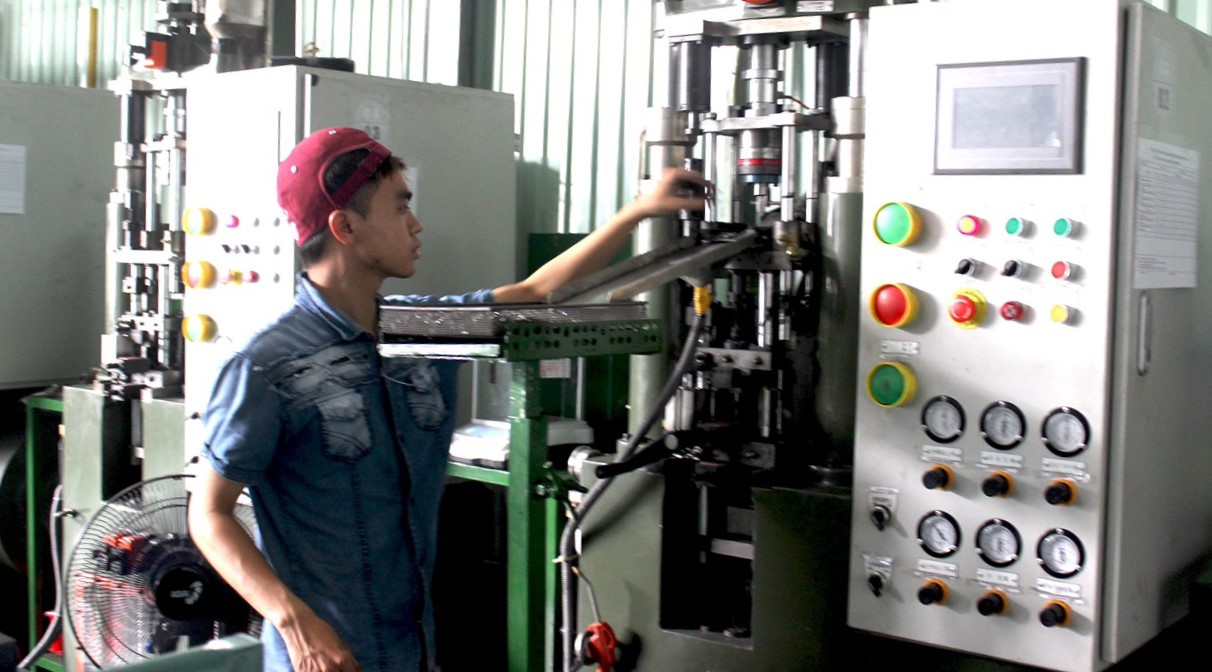
Exported component production in an enterprise
in Nhon Trach 3 IP
According to the Vietnam Chamber of Commerce and Industry, RCEP would have been the world's biggest trade deal as it is covering almost 40 percent of global GDP. Therefore, RCEP is expected to bring a new change to regional and global trade.
The largest trading bloc
When the RCEP agreement is implemented, it will create a market with 16 participating countries, to strongly promote the development of regional and global value chains.
Minister of Industry and Trade Tran Tuan Anh said: “RCEP are pushing for a review of legal documents, hoping that this deal expected to be signed in late 2020. When the RCEP agreement is implemented, it will create a market of more than 3.5 billion consumers and total GDP of approximately US$49 trillion, accounting for 40% of global GDP”. RCEP bloc will also become the largest free trade area in the world with commitments on market opening in the fields of goods, services and investment, simplification of customs procedures, and rules of origin to facilitate trade.
However, RCEP is scheduled to be officially signed by year’s end without India, so this agreement has not been as expected by the participating countries. But RCEP will keep the door open for India in case it decides to rejoin the trade deal in the future.
Enterprises in Dong Nai are quite interested in RCEP as this is their big import-export market. At the same time, some countries participating in said agreement are also major investment partners in Dong Nai such as Korea, Japan, Singapore, China. Therefore, when RCEP is signed, it will help Dong Nai expand its import-export and attract foreign direct investment.
Mr. Vo Thanh Tuan, Director of An Phu Thinh Joint Stock Company (Long Thanh District) said: “Our products with over 60% quantity are exported to Japan, ASEAN and the EU. We hope that RCEP will be signed soon so that taxes can be reduced, customs procedures will be simpler, businesses will be easier to expand consumption markets in countries participating in such agreement.”
In addition to the advantages, businesses also have to face with difficulties as when the tariffs of many items drop to 0%, domestic goods will be fiercely competed with imported goods. Thus, manufacturing enterprises mainly consuming in the domestic market may face more fierce competition in its production and market share.
Taking advantage of RCEP
The RCEP negotiation includes: trade in goods, trade in services, investment, economic and technical cooperation, intellectual property, competition, dispute settlement, e-commerce, small and medium enterprises (SMEs) and other issues.
As the ASEAN Chair in 2020, Vietnam will have to shoulder a very important task of promoting the conclusion of negotiations for the remaining contents in the RCEP agreement. So far, Vietnam has signed 13 bilateral and multilateral free trade agreements and is negotiating 3 agreements: RCEP, Vietnam-Israel and Vietnam-EFTA (including Norway, Switzerland , Iceland, Liechtenstein).
As soon as the RCEP is signed, Vietnam will become one of the world's leading countries to participate in rapid and broad integration. There are 3 largest free trade agreements in the world namely CPTPP, EVFTA and RCEP, and Vietnam has all participated. It is expected that Vietnam's trade with China, Korea, Japan, the three major partners in the RCEP, and CPTPP will increase sharply.
Mr. Tran Ngoc Liem, Deputy Director of Vietnam Chamber of Commerce and Industry - Ho Chi Minh City branch said: “If businesses want to grasp the advantages of RCEP, they must study the agreement, the field they are producing and trading in so that they have a plan to prepare in advance. Thus, when RCEP is signed, opportunities can be immediately taken advantage of. With the RCEP, Vietnam has the advantage of having a separate bilateral free trade agreement with a number of countries”. Most businesses in Vietnam expect that, by the end of this year, when the RCEP is signed and the COVID-19 also subsides, this will be the time to "accelerate" exports; And provinces/ cities can complete the targets for 2020 and the period 2016-2020 in attracting foreign investment, creating momentum for economic development in the next 5 years (2021-2025).
Vi Quan
Newer articles
Older articles
Today
Total

