Despite difficulties, Dong Nai’s export surplus still increased by nearly USD 700 million over the same period in 2019. Its trade surplus in first 9 months of this year reaches nearly 30% nationwide. This province’s goal is to have a trade surplus next year to be higher than the previous year and in a stable position.
Department of Industry and Trade reported a trade surplus of nearly USD 3.1 billion in the first 9 months of 2020.
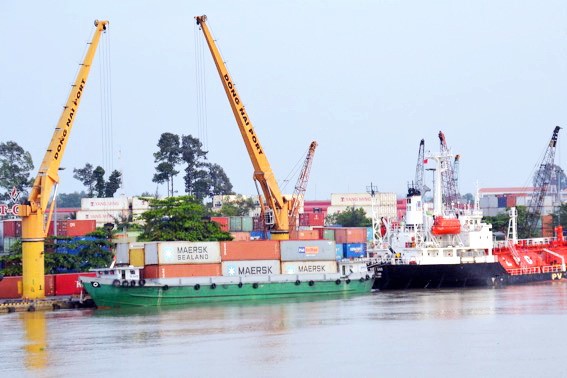
Export goods at Dong Nai Port.
*Increasing use of domestic inputs
In recent years, Dong Nai’s enterprises have actively sought to buy domestic materials to replace imported materials. Therefore, the province’s annual trade surplus has increased. Enterprises in the domestic supporting industry are also developing, diversifying a variety of products. However, this supporting industry in Dong Nai as well as the whole country still has limitations, as raw materials for this industry still have to be imported quite a lot. Therefore, Vietnam’s industrial production is still not really sustainable because it cannot actively source raw materials for its production.
Mr. Tetsuji Kobayashi, General Director of Kobe En & M Vietnam Co., Ltd. located in Bien Hoa 2 IP, said: “We specialize in producing all kinds of electric generator for consumption in domestic market and exporting to ASEAN countries. The source of raw materials for the production company is large iron, which is difficult to find in Vietnam, so it is forced to import from many countries”. According to Mr. Tetsuji Kobayashi, if Vietnam can supply raw materials for supporting industrial production, it will form a sustainable industrial production chain.
Over the past 5 years, the Government has prioritized calling for the development of supporting industries that have brought about some positive results, which is the increase in trade surplus each year. Economic experts and enterprises say that Vietnam should have policies to further develop the raw material manufacturing industry, because the supply of such supporting industries is more active in industrial production and increases the added value.
Mr. Chau Minh Nguyen, Vice Chairman of Dong Nai Enterprises Association, shared: ”In recent years, supporting industries in Dong Nai as well as the whole country have been quite developed. Dong Nai has become a major source of input products for the country, but raw materials for the industry to support production are mostly imported from China, Korea, Taiwan, etc”. In an industrial production chain, if there is no active stage, it will lose its sustainability.
*Aiming for high export surplus
If the global COVID-19 epidemic is controlled, Dong Nai’s export surplus in 2020 could reach USD 4.2 billion, which means the highest level ever. Dong Nai continues to make adjustments in attracting foreign investment by selecting industries with high added value and supporting industries for the sustainable development of the industry. To get high added value, it is imperative to be proactive in sourcing raw inputs, from raw materials to supporting industries, product completion and export.
Ms. Nguyen Thi Thuy Ha, Director of Professional Division, Kureha Vietnam Co., Ltd. in Amata IP (Bien Hoa City) said: “All businesses want to find domestic raw materials to actively produce. Domestic raw materials are of the same quality and prices that are equal to or slightly higher than imported goods, businesses will choose to buy. Using domestic raw materials Enterprises can easily enjoy tax incentives when selling goods through countries in which Vietnam has signed free trade agreements.”
Most free trade agreements provide for the localization rate of products to enjoy tariff preferences. For example, with the garment industry, it requires localization from yarn production, to fabric and finished products. Dong Nai has one of the most developmental supporting industries in the country, of which more than 60% of total exports are in supporting industries, but raw materials of many industries are still inactive. This is a weakness in industrial production that requires a policy to attract investment and encourage industrial development into a chain, be proactive in each new sustainable stage.
Author: Vi Quan
Newer articles
Older articles
Today
Total

